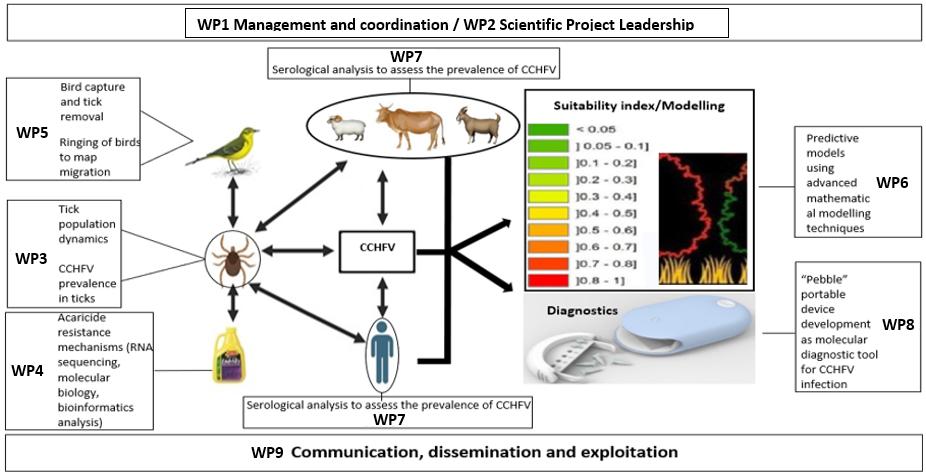
WP1 Management and coordination of ResTick
Objectives: Developing a streamlined project plan, assigning clear roles, and establishing effective communication and innovation development channels between the partners-countries. The focus is on fostering collaboration, monitoring progress, and addressing challenges to ensure timely completion of each work package.
Tasks:
1.1: Project Deployment and Management
1.2: Coordination of Interactions with the Research Network and Other Projects
1.3: Data Management, Ethics and Gender Balance Plan
WP2 Scientific Project Leadership
Objectives: Designation and appointment of a scientific project leader (SPL) established in a SSA country (Uganda) member of the EDCTP Association responsible for scientific governance, leadership actions, external communication and collaboration with the coordinator on the project monitoring.
Tasks:
2.1: Acting as the key contact point for the GH EDCTP3 JU alongside the coordinator on scientific governance & leadership actions including external communication
2.2: Monitoring that the scientific tasks are implemented properly, e.g., reviewing deliverables before their submission to the GH EDCTP3 JU
2.3: Collaborating with the coordinator on the project monitoring and the adoption of appropriate internal measures to ensure that beneficiaries are fulfilling their obligations
WP3 Tick spp identification and CCHFV genotype characterization vectored by ticks in SSA
and Crete
Objectives: A comprehensive study of tick populations and tick-associated CCHFV genotypes in SSA and the island of Crete, to ecologically explore tick dynamics and associated risks of tick-borne viral diseases across numerous locations of Crete to Sub-Saharan Africa. The program involves identifying tick species, analysing tick-borne viral pathogens, and investigating ecological relationships to comprehend disease transmission dynamics. The research aims to offer ecologically informed insights for developing tailored mitigation strategies and implementing public health interventions across Europe and Africa.
Tasks:
3.1: Criteria for Farm Selection
3.2: Tick Collection
3.3: Tick Species Identification
3.4: CCHFV Prevalence and Genotyping
WP4 Acaricide resistance of ticks from SSA and Crete
Objectives: Using advanced molecular tools, analyse acaricide resistance in SSA countries and Crete's tick populations. Define molecular determinants associated with resistance across major acaricide classes, establishing a regional reference. Investigate novel resistance mechanisms through RNA sequencing and bioinformatic analysis to gain insights into mutations and metabolic pathways mediating resistance. Determine the gender segregated knowledge, attitudes and practices that precipitate emergence and spread of acaricide resistance; thereby providing an information tool kit that can be used to limit the emergence and spread of acaricide resistance. Overall, the goal is to comprehend resistance dynamics, providing evidence-based recommendations for effective tick population control and limit the menacing effects of acaricide resistance.
Tasks:
4.1: Monitoring Molecular Determinants of Acaricide Resistance in Tick Populations
4.2: Identifying Novel Acaricide Resistance Mechanisms: Target Site Mutations and Metabolic Resistance
WP5 Study of avian ecology in SSA and Crete
Objectives: Focusing to capture migrating birds during both spring and autumn along the East and West Africa Eurasia corridor and the Mediterranean route through Crete. The project will evaluate tick infestation of birds, bird-mediated tick transportation, and the role of migrating birds in spreading tick-borne diseases.
Tasks:
5.1: Bird Migration Survey Using Ringing
5.2: Tick Transport Survey by Passage Migrants
WP6 Predictive models for tick and CCHFV abundance using advanced mathematical modelling techniques
Objectives: The primary objective of this work is to enhance predictive models for tick abundance using advanced mathematical modelling techniques informed by real-time data generated through ResTick research activities. This initiative aims to address critical knowledge gaps in the specific scientific field by incorporating cutting-edge methodologies, including resampling-based model selection and penalized regression methods. We will develop spatial predictive models for tick abundance and disease risk, with a particular focus on (CCHFV).
Tasks:
6.1: Resampling-Based Model Selection for Quantile and Zero-Inflated Poisson (ZIP) Regression designed to handle skewed and zero-inflated ecological data
6.2: Evaluation Against Bayesian Model Selection Procedures
6.3: Regional Predictive Maps
WP7 Serological analysis to determine the exposure of cattle, sheep and goats, including humans, to CCHFV
Objectives: To conduct serological analysis on cattle, sheep and goats (300 animals per year) to assess exposure to CCHFV. Measure antibody titres and investigate cross-species transmission dynamics. Sampling areas will align with those used for ticks, with sera collected from animals only when found to be infested with ticks. Additionally, WP7 encompasses studies of CCHFV exposure in 2000 humans per year, focusing on high-risk areas defined by the literature at the beginning of the project and the mathematical models developed by WP6 as the project progresses.
Tasks:
7.1: Investigating Pathogen Exposure in Livestock
7.2: Strategic Studies on CCHFV Exposure in Humans
WP8 Optimization of molecular diagnostic methods for the identification of CCHFV in livestock, humans, and ticks
Objectives: Optimizing molecular diagnostic methods for the exclusive identification of CCHFV in livestock, our goal includes developing an affordable Crimean-Congo Haemorrhagic Fever Virus (CCHFV) detection kit, adapting the existing Pebble portable device. To validate its accuracy using whole blood samples from animal species. The project also involves comparing the CCHFV Detection Kit with traditional diagnostics and conducting field testing in diverse livestock populations. Documenting the entire process and establishing a framework for continuous improvement are integral components of WP8.
Tasks:
8.1: Assessment of CCHFV Genotypes in Livestock
8.2: Development of Field-Deployable Diagnostic Kits
WP9 ResTick communication, dissemination and exploitation
Objectives: Robust communication strategy, engaging stakeholders such as local communities, researchers, public health agencies, the tourist industry, and policymakers. Disseminate research findings effectively through scientific publications, conferences, and public awareness campaigns, utilizing local media channels. Educational initiatives will target healthcare professionals, farmers, tourist managers, and the public to elevate awareness regarding ticks and tickborne diseases. Exploitation objectives include identifying opportunities for further research, innovation, and policy development, fostering collaboration with industry partners and research groups. Monitoring and evaluation mechanisms will gauge communication effectiveness, with efforts to influence policies based on project findings, emphasizing data and resource sharing for lasting impact.
Tasks:
9.1: Communication and Dissemination
9.2: Exploitation